Showing posts with label Church. Show all posts

15 April 2012

Easter People


Our spirituality is an Easter spirituality! It is marked by joy and optimism permeated by the peace of the Risen Lord.

It was Easter Sunday, 12th April of 1846 when Don Bosco moved with his young people to the Pinardi shed. This was to be their permanent home after five years of  wandering from one place to another.
For Don Bosco this was a truly Easter experience; only the week before he was desperate;


  • < I said nothing at all, but everybody knew how troubled and worried I was… I withdrew to one side, and as I walked alone I began to cry, perhaps for the first time. As I walked I looked up to heaven and cried out, "My God, why don't you show me where you want me to gather these children? Oh, let me know! Oh, show me what I must do!" > 


When all seemed hopeless, God provided, and by the following Sunday, which was Easter, they were settled in their new place. It was fitting therefore for Don Bosco to be canonized on Easter Sunday 1934.
Our reflections this month help us to enter more fully into this Easter spirit of joy in action.  Mary Magdalene highlights the feminine role in proclaiming the Easter joy, a joy reflected in that of Mary Mazzarello in Mornese.
CONFORT
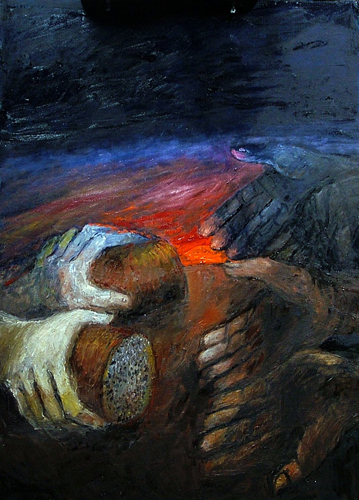


The Resurrection stories of these Easter days come from the early communities that are proclaiming the Good News with joy and thanks. They have had this intimate transforming   encounter with the Lord whose tomb is empty as is every tomb who tries to claim us in death because love is stronger than death.  The tomb henceforth becomes the womb of new and eternal life
This awareness and understanding for them as for us gradually unfolds.  The cloud of unknowing is slowly and patiently lifted and stranger is recognized as friend.In this context   he reveals himself in word and gesture. Familiarity occurs as bread is broken,  names are called in love,  empty tombs are searched, burning hearts are felt,   nets are cast again, lakeside breakfast served,  peace breath is felt and wounds are touched. All is the same yet everything is totally changed. His appearances empowered and transformed them. As Easter people they understood themselves and embraced their birthright and new identity as Children of the Living God, free to be witnesses and proclaimers of Gods life-giving love for all.
These Easter days are our Emmaus journey. Just as we grapple with the reality of death we also struggle with the mystery and reality of life after death.

18 March 2011

St Joseph song - How could it be?

To you, O blessed Joseph,
do we come in our tribulation,
and having implored the help of your most holy spouse,
we confidently invoke your patronage also.

Through that charity which bound you to the Immaculate Virgin Mother of God and through the paternal love with which you embraced the Child Jesus,
we humbly beg you graciously to regard the inheritance which Jesus Christ has purchased by his Blood,
and with your power and strength to aid us in our necessities.

O most watchful Guardian of the Holy Family, defend the chosen children of Jesus Christ;
O most loving father,
ward off from us every contagion of error and corrupting influence;
O our most mighty protector,
be propitious to us and from heaven assist us in our struggle with the power of darkness;
and, as once you rescued the Child Jesus from deadly peril, so now protect God?s Holy Church from the snares of the enemy and from all adversity;
shield, too, each one of us by your constant protection,
so that, supported by your example and your aid, we may be able to live piously, to die holily, and to obtain eternal happiness in heaven. Amen.


09 February 2011

St Paul's Shipwreck - something to celebrate.

The 10th of February is a special day on the island of Malta, for on that day people celebrate the feast of the shipwreck of St Paul. this occured in the year 60 AD and is recoreded in the last chapter of the Acts of the Apostles. Last year was the 1950th annivesary of this event and Pope Benedict XVI visited the island to mark the occasion. Here we bring some extracts from his homily; these were delivered when the Pope himself was experiencing a his own storm in the media.


The Holy Father praying at the Grotto of St Paul in Rabat during his visit to Malta.


“Saint Paul’s arrival in Malta was not planned. As we know, he was travelling to Rome when a violent storm arose and his ship ran aground on this island. Sailors can map a journey, but God, in his wisdom and providence, charts a course of his own. Paul, who dramatically encountered the Risen Lord while on the road to Damascus, knew this well. The course of his life was suddenly changed; henceforth, for him, to live was Christ (cf. Phil 1:21); his every thought and action was directed to proclaiming the mystery of the Cross and its message of God’s reconciling love.

“That same word, the word of the Gospel, still has the power to break into our lives and to change their course. Today the same Gospel which Paul preached continues to summon the people of these islands to conversion, new life and a future of hope. Standing in your midst as the Successor of the Apostle Peter, I invite you to hear God’s word afresh, as your ancestors did, and to let it challenge your ways of thinking and the way you live your lives.” [St Paul’s Grotto, 17th April 2011, Rabat]

“[In] the account of Paul’s shipwreck on the coast of Malta, and his warm reception by the people of these islands [we] notice how the crew of the ship, in order to survive, were forced to throw overboard the cargo, the ship’s tackle, even the wheat which was their only sustenance. Paul urged them to place their trust in God alone, while the ship was tossed to and fro upon the waves. We too must place our trust in him alone. It is tempting to think that today’s advanced technology can answer all our needs and save us from all the perils and dangers that beset us. But it is not so. At every moment of our lives we depend entirely on God, in whom we live and move and have our being. Only he can protect us from harm, only he can guide us through the storms of life, only he can bring us to a safe haven, as he did for Paul and his companions adrift off the coast of Malta. They did as Paul urged them to do, and so it was “that they all escaped safely to the land” (Acts 27:44).
“More than any of the cargo we might carry with us – in terms of our human accomplishments, our possessions, our technology – it is our relationship with the Lord that provides the key to our happiness and our human fulfilment. And he calls us to a relationship of love…” [18th April 2011 – Floriana]

07 February 2011

St. Josephine Bakhita of Sudan

 Today,February 8, is the feast day of St. Josephine Bakhita. She was born in what is today the troubled region of Darfur, Sudan around 1870. St. Bakhita was canonized by Pope John Paul II in the Jubilee Year 2000, and is cited by Pope Benedict XVI in his encyclical, Spe Salvi as an inspiring example of Christian hope.

... at this point a question arises: in what does this hope consist which, as hope, is “redemption”? The essence of the answer is given in the phrase from the Letter to the Ephesians quoted above: the Ephesians, before their encounter with Christ, were without hope because they were “without God in the world”. To come to know God—the true God—means to receive hope. We who have always lived with the Christian concept of God, and have grown accustomed to it, have almost ceased to notice that we possess the hope that ensues from a real encounter with this God. The example of a saint of our time can to some degree help us understand what it means to have a real encounter with this God for the first time.

I am thinking of the African Josephine Bakhita, canonized by Pope John Paul II. She was born around 1869—she herself did not know the precise date—in Darfur in Sudan. At the age of nine, she was kidnapped by slave-traders, beaten till she bled, and sold five times in the slave-markets of Sudan. Eventually she found herself working as a slave for the mother and the wife of a general, and there she was flogged every day till she bled; as a result of this she bore 144 scars throughout her life.

14 December 2010

Towards a humble Church


Reflection


Timothy Radcliffe, OP (1945, London–) is a Dominican friar of the English Province, and former Master of the Order of Preachers from 1992-2001. He is now highly sought after speaker, teaching and preaching in many countries.
Friendship with Jesus – intimacy –means learning to be gentle and lowly of heart. Then we shall find rest for our souls. But if one thinks of the Catholic Church, the first word that springs to mind might not be “humble”.
I have given retreats for dioceses in 15 countries since I finished my term as Master of the Dominican Order in 2001. The vast majority of priests and bishops whom I have met are simple and unpretentious people who just wish to serve the people of God. But this personal humility has to be sustained in the teeth of a clerical culture, common to all Christian denominations, which stresses rank and power.

24 September 2010

The Stole and the Apron

Stole and apron:to put the two of them on together may sound disrespectful, almost an act of desecration.
The stole is made for the sacristy, kept neatly with the finely decorated chasubles and all the other sacred linens, amidst the perfume of incense and the mystical language of biblical symbols. There is no newly ordained deacon or priest who has not received a beautiful and precious stole as a gift from a convent of Sisters.
The apron belongs to the kitchen among the frying pans, the bags of flour and jars of oil, the vegetables and other ingredients, and the plates to be washed... or in the store with the domestic cleaning materials. No one would think of giving an apron as a gift, for a wedding or a birthday, much less for an ordination.
And yet the apron is the only liturgical dress mentioned in the Gospel... yes, the Gospel, and the most theological of the four - the holy gospel according to John!
For Christ’s first solemn Mass, the first Mass in the history of the universe, celebrated the night before he died, there is no mention of alb, stole or chasuble, but only of a rough piece of cloth, the apron that Jesus put on, the perfect priestly garment. 
Maybe it would be good for us to complete the equipment of our sacristies by including an apron among the golden decorated chasubles, dalmatics and stoles and the finely embroidered albs.    

19 September 2010

BEATIFICATION OF VENERABLE CARDINAL JOHN HENRY NEWMAN

HOMILY OF HIS HOLINESS BENEDICT XVI

Pope Benedict XVI presided at the beatification of Blessed John Henry Newman on September 19 2010, in the culminating act of a 4-day visit to the United Kingdom. 
 In an outdoor liturgy attended by 70,000 people at Crofton Park in Birmingham, the Holy Father pronounced the beatification of the 19th-century British scholar and convert. 
The Pope focused on the figure of Cardinal Newman, whose many writings helped to illuminate “the vital place of revealed religion in civilized society, and into the need for a broadly-based and wide-ranging approach to education.” In his remarks the Pope said that Cardinal Newman’s “fine Christian realism” was a reliable guide for today as well. He pointed out that Newman “would describe his life's work as a struggle against the growing tendency to view religion as a purely private and subjective matter, a question of personal opinion.” That same struggle continues today, the Pope said, “when an intellectual and moral relativism threatens to sap the very foundations of our society.” 
Cardinal Newman’s life "also teaches us that passion for the truth, intellectual honesty and genuine conversion are costly,” the Pope said. Truth must be proclaimed, even sometimes at personal cost. Finally, the Pope observed, Cardinal Newman insisted that “there can be no separation between what we believe and the way we live our lives.” 


18 September 2010

Cardinal John Newman

Beatification


The beatification of Cardinal John Newman is of particular significance for the Church. The following is the LETTER OF THE HOLY FATHER JOHN PAUL II ON THE OCCASION OF THE 2nd CENTENARY OF HIS BIRTH WHICH WAS ADDRESSED To The Most Reverend Vincent Nichols, WHO WAS Archbishop of Birmingham AT THE TIME.


Pope Benedict’s apostolic journey to the United Kingdom culminates on September 19 with the beatification of Venerable Cardinal John Henry Newman, described by Venerable John Paul II as “one of the most distinguished and versatile champions of English spirituality” and as a thinker who came to “a remarkable synthesis of faith and reason.”Hailed by James Joyce as “the greatest of English prose writers,” Newman was at once a seminal theologian (An Essay on the Development of Christian Doctrine, An Essay in Aid of a Grammar of Assent), a poet (“The Pillar of the Cloud,” “Dream of Gerontius”), the leading defender of liberal education in his day (Idea of a University), the author of a classic spiritual autobiography (Apologia Pro Vita Sua), and a preacher with an eloquence perhaps unsurpassed in the English language, from his Anglican Parochial and Plain Sermons to his Catholic Sermons Preached on Various Occasions. 

Born in 1801, Newman became an Anglican cleric in 1825; seven years later, he helped launch the Oxford Movement, which sought to emphasize and restore the Catholic aspects of the Church of England while conceiving of Anglicanism as a via media between Rome and Protestantism. In 1845, he was received into the Church by Blessed Dominic Barberi. Ordained to the priesthood in Rome in 1847, Newman brought the Congregation of the Oratory to England the following year. 

Pope Leo XIII created Newman a cardinal in 1879. Upon his death in 1890, the Guardian hailed him as “one of the very greatest masters of English style,” “a man of singular purity and beauty of character,” and “an eminent example of personal sanctity.” Pope John Paul II declared Newman venerable in 1991, and the Congregation for the Causes of Saints issued a decree last July that cleared the way for his beatification. 

20 June 2010

United to Christ

Benedict XVI to Priests on Holy Thursday

This week  is the feast of St Joseph Cafasso, Spiritual Director of Don Bosco. He died 150 years ago on the 23rd of June 1860 at the age of only 49. He was indeed a wise spiritual director able to discern God's action in Don Bosco's life. Let us mark his day in humble gratitude for the role he played in Don Bosco's vocation and in the founding of the Salesian Society, as we pray that we too may like Don Bosco seek to be in spiritual direction so as to discern God’s will in our lives.
As an aid to reflect on the priesthood, in this edition we are bringing a synthesis of the Pope’s homily on Holy Thursday at the Chrism Mass. Indeed it is a beautiful reflection on the priesthood.
One way of marking the feast of St Joseph Cafasso is to have a penitential service in community and  facilitating the possibility of confession and/or spiritual direction as we bring the Year of the Priest to a close in community.


16 May 2010

Word made . . . digital

World Day of Social Communication

In his message for the Catholic Church's 2010 World Day for Social Communications, Pope Benedict XVI called on the ministry to use the latest technologies, such as Web sites and blogs, to preach the gospel and encourage a dialogue with their practitioners.

Scheduled for May 16, the theme of the World Day will be "The Priest and Pastoral Ministry in a Digital World: New Media at the Service of the Word." In his message for the world day of social communications, Pope Benedict told people that church communities have traditionally relied on modern media to open the lines of communication. And as the culture changes, the church needs to use the latest technologies, especially if it wants to reach younger people.


The Church itself has taken initiative to bring its message to the web; checkout these sites:

10 April 2010

Priesthood


Prayers for Priests
You came from among us
to be, for us, one who serves.
We thank you for ministering Christ to us
and helping us minister Christ to each other.
We are grateful for the many gifts you bring to our community:
for drawing us together in worship,
for visiting us in our homes,
for comforting us in sickness,
for showing us compassion,
for blessing our marriage,
for baptising our children,
for confirming us in our calling,
for supporting us in bereavement,
for helping us to grow in faith,
for encouraging us to take the initiative,
for helping the whole community realise God's presence among us.
For our part, we pray that we may always be attentive to your needs
and never take you for granted.
You, like us, need friendship and love,
welcome and a sense of belonging,
kind words and acts of thoughtfulness.
We pray, also, for the priests who have wounded priesthood.
May we be willing to forgive
and may they be open to healing.
Let us support one another during times of crisis.
God our Father, we ask you to bless our priests
and confirm them in their calling.
Give them the gifts they need
to respond with generosity and a joyful heart.
We offer this prayer for our priest,
Who is our brother and friend,
Amen