16 August 2014

EXPOSED TO LOVE


A Bicentenary Reflection on Don Bosco's Mission amongst the young. 
  

1 Exposure
Don Bosco is  ordained a priest;
He goes  to the city
·         He walks its street,
·         he enters the slums,
·         he visits the prisons.

“I was horrified! I saw large numbers of youth, fine healthy youngsters, alert of mind, - seeing them idle there, infested with lice, lacking food for body and soul, really shocked me.
Public disgrace, family dishonour, and personal shame were personified in those unfortunates.
What shocked me most was to see that… they were aban­doned to their own resources.”
·         Don Bosco still walks the streets today
·         Still goes to the cities
·         Still meets the young.

2 Rejection:

It was a dark night when I came upon the little boy.
Who are you? I asked.
He replied.
I am abandoned.
I am alone.
I am an outsider, even in my own family.
I belong no where.
I belong to no one.
Living hurts me.
Each day I hear that I am nobody.
I am a throw away.
I am a mistake.
I am a burden.
I am a parasite.
People are right to get rid of me.
People are right to want me out of the way.
I am without a home.
I am without any true friends,
          Because I cannot trust anyone enough
          To let them be a friend.
The people who hurt me most
are the people I once trusted.
I am never going to trust another person again.
I know that there are others like me but that’s no comfort.
We live in quarantine
          each an inhabitant of his own universe.
Everyone else is a stranger, a user.
Each meeting with another person is just
          Another opportunity for being rejected
Another opportunity for being kicked
Another opportunity for being thrown away
For being told I am nothing
That I am useless
That I am trash
That I should never have been born.

3 MINISTRY

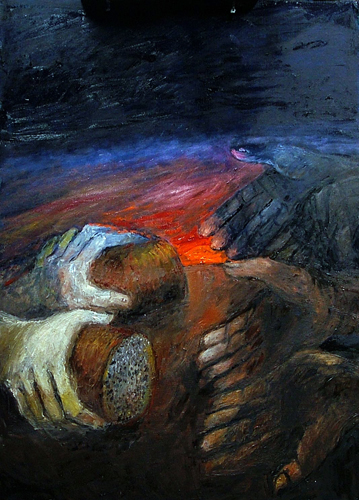
How can I minister to one who is so alone, to one who is so lost and so hurt? How can I break the good news upon him, upon her? How can I heal when everything says it is too late for healing, the damage is gone too far, the hurts are too deep? How can I say welcome to someone who does not know the meaning of home?

Don Bosco also was in anguish as to how he could reach out to them. He was disturbed by their situation but left it “to the Lord's grace what the outcome would be. Without God's grace, all human effort is vain.”

Scene : A youth sneaks into a sacristy.

  I come to you who are wounded, and lost in your world of pain. What do I say to you? Be healed? Not yet because you are not ready to hear it.
First, I show you my wounds because if I have no wounds I cannot heal you. I minister from my wounds. I minister from my brokenness. Paul tells me to be proud of my weakness. Paul tells me in my weakness is my strength. If I accept my wounds and if I let you touch them, then together we can go to Jesus. By his wounds we are healed.

Don Bosco too carried a deep wound – the loss of his father left a mark on him. His whole life was a search for the missing father he never had. His meeting with Garelli touched on this wound, and in reaching out from this wound he would become the father of so many poor youth. His whole life took on a meaning by becoming that which he himself never had.

Don Bosco had enough personal experience to know that for a child or young person in need,
the present moment is the only reality that he or she knows.
That is why,inspired by the Gospel call to welcome a child, he offered to help the young immediately
“Do you want to start now?”


4 Affirmation


Dawn was beginning to break when I came on the little boy. “Who am I?” he asked. I replied:
“You are accepted just the way you are.
You are cherished.
You will never be alone again.
You are of enormous value.
You have a dignity no one can take away from you.
You have a place you can call your own.
You have people around you
          Who care for you and who love you
Life now can become something we can celebrate together
Each day we will grow to understand new depths of beauty
          New heights of life’s mystery, which is love.
You can begin to trust again,
          For you are loved
          You are loveable
You have no need to be afraid
It is never too late for healing
It is never to late for love.


5 Kairos

One day I met a wise old man and I asked him, “What do I need if I am to minister to the homeless, to the broken?”
He answered. Remember. Remember all the home-coming stories you ever heard. The bible is a story of home-coming. Only in God can we really be at home. Let the homeless teach you. Through them you will learn the depth of yearning that is in all our hearts.


His Name is Today

We are guilty of many errors, of many faults,
but our worst crime is abandoning the children,
neglecting the fountain of life.
Many of the things we need can wait.
The child cannot.
Right now is the time his bones are being formed,
his blood is being made and his senses are being developed.
To him we cannot answer Tomorrow.
His name is "Today."
. Gabriela Mistral  (Nobel Prize-winning poet from Chile)

Magnifcat


A simple Hail Mary was the start of his work.
Let us sing that beautiful prayer asking Mary to once again intervene through us on behalf of the young and rejoice with her for the great things God has done for his little ones.


This Reflection on Don Bosco for the opening of the Bi-Centenary Celbrations can also be watched on Youtube.


13 January 2013

Don Bosco Our Model


Our Salesian call 
When we think of our call to the Salesian life, how many of us can say: “I decided to be a Salesian after going through a deep study of the Preventive System and the Salesian Spirituality”?  How many of us can rather say: “If I am a Salesian it is because of father or brother so and so … My vocational journey started when I met him and I said to myself: “I would like to be like him!”.
Since this second alternative has been my experience I tend to think that the majority of the Salesians could say the same.
Models play an important role in the life of a person, especially at the early stages.  
 From the Constitutions
The Salesian spirit finds its model and source in the very heart of Christ, apostle of the Father”. (C11)
“We study and imitate him (Don Bosco)”. (C21)
“Our living rule is Jesus Christ… whom we find present in Don Bosco who devoted his life to the young”. (C196)
“The first Salesians found their sure guide in Don Bosco. Living at the very heart of his community in action, they learned to model their own lives on his. We too find in him our model”. (C97)

1. Looking at the model The Lord has given us Don Bosco as Father and Teacher. Before being Father and Teacher of the youth, Don Bosco is OUR Father and Teacher!
As a father Don Bosco reflects in a special way the “fatherhood’ of God. All his life he displayed a father’s heart. He said to his Salesians: ”No matter in what remote part of the world you may be, never forget that here in Italy you have a father who loves you in the Lord”.
As a teacher Don Bosco reproduces some features of the Divine Master, Jesus Christ, who has been his guide from the first dream at the age of nine. Of Jesus Don Bosco incarnated certain aspects: gratitude for the gift of vocation, predilection for the little ones, zeal in preaching and saving, the gentleness and self-giving attitude of the Good shepherd. (C11)
Before being a teacher, Don Bosco is a good disciple! He reflects Jesus in his life and points to Jesus as the perfect model: “He will always be our Master, our Guide , our Model”. Don Bosco is there with all his “splendid blending of nature and grace … deeply human and deeply the man of God … with a closely-knit life project, the service of the young”.

24 May 2012

We Believe....


“Blessed is she who believed”
It is interesting how sometimes discoveries or insights happen because of an accident or mistake.  This is what happened to me; I once had such an insight which really came about more through a mistake on my part.
A number of years ago I formed part of our Community in Tunisia, where we Salesians run  a school for seven hundred children all of whom are Muslims, including the teaching staff. Being in a Muslim country, there was no possibility of even mentioning the name of Jesus. Therefore a title like Mary Help of Christians may seem out of place in such a context. Tunis is also a French speaking country and the title Mary Help of Christians is translated as Marie Secours des Chrétiens.
Now here is where my ignorance in French came in. The word Chrétiens, sounds very much like the word Credenti in Italian which means believers. I used to say to myself what a wonderful idea to express the title Mary Help of Christians as  Mary Help of Believers. For indeed we are all believers, Muslims and Christian alike, in the one true God and Mary helps us to deepen our faith.  The challenge in today’s world is not so much as the clash of civilizations or struggle between different faiths, but rather the struggle against the systematic onslaught  by atheistic secularism seeking to obliterate any reference to God.
So Mary is truly a Help to those who believe. So many of our young people, when they encounter this secular and materialistic environment, are taken over. In the gospels, we see Mary being greeted by Elizabeth: “Blessed is she who believed that what the Lord has said will come true.” Lk1:45 She is the first one to believe, to ponder these things in her heart.     It is because of his disbelief that Zechariah was struck dumb. Our lack of faith also makes us unable to express ourselves, strikes us dumb and we find ourselves limited in expressing and communicating ourselves. We on our part very often have to struggle in our faith, a struggle so well expressed in the Gospel “Yes Lord I do believe; help my unbelief.Mk9:24
But if we do have faith, we can with Mary let our souls sore high and proclaim with her: “My soul magnifies the Lord”. Lk1:46


Company Motto

Many companies and businesses nowadays have a mission statement, a short phrase that captures what the company is all about. The phrase is usually short and catchy, easy to memorize. In its simplicity it communicates to all, both consumers as well as workers, reminding them what their purpose is all about.
I would like to suggest that Don Bosco has given us such a mission statement and we may not realize it. It has been staring us in the face. What is this statement? Some identify it as ‘Honest citizens good Christians’. This is indeed very true but it talks of what we want to achieve in our students, and does not touch on what we ourselves are called to be.
No, our mission statement given to us by Don Bosco  is a phrase that has been staring us in the face. And this is Help of Christians. Yes Mary Help of Christians is a personification of our Salesian Charism, our Salesian vocation, of our Salesian identity. In Mary we see what are called to be and do. We are called to be a help to all the young people that we meet to grow in their faith. This would involve sharing our faith journey, at times our own struggles and doubts.
General Chapter XXIII was dedicated to this theme – Educating young people to the Faith. Mary is the Help; she cannot but not be actively involved. Her immediate and spontaneous reaction has been to set out in haste to help Elizabeth in her need. At Cana she cannot but observe that they lacked wine and she could not but intervene.  

We too are called to be a help, and in Mary we find a model. Devotion to Mary help of Christians will help us to grow and be affirmed in our vocation. As the Immaculate one she reminds of our consecration giving ourselves totally to God. As Help of Christians she reminds of the zeal we have to have for souls. Da Mihi Animas.  

15 April 2012

Easter People


Our spirituality is an Easter spirituality! It is marked by joy and optimism permeated by the peace of the Risen Lord.

It was Easter Sunday, 12th April of 1846 when Don Bosco moved with his young people to the Pinardi shed. This was to be their permanent home after five years of  wandering from one place to another.
For Don Bosco this was a truly Easter experience; only the week before he was desperate;


  • < I said nothing at all, but everybody knew how troubled and worried I was… I withdrew to one side, and as I walked alone I began to cry, perhaps for the first time. As I walked I looked up to heaven and cried out, "My God, why don't you show me where you want me to gather these children? Oh, let me know! Oh, show me what I must do!" > 


When all seemed hopeless, God provided, and by the following Sunday, which was Easter, they were settled in their new place. It was fitting therefore for Don Bosco to be canonized on Easter Sunday 1934.
Our reflections this month help us to enter more fully into this Easter spirit of joy in action.  Mary Magdalene highlights the feminine role in proclaiming the Easter joy, a joy reflected in that of Mary Mazzarello in Mornese.
CONFORT


The Resurrection stories of these Easter days come from the early communities that are proclaiming the Good News with joy and thanks. They have had this intimate transforming   encounter with the Lord whose tomb is empty as is every tomb who tries to claim us in death because love is stronger than death.  The tomb henceforth becomes the womb of new and eternal life
This awareness and understanding for them as for us gradually unfolds.  The cloud of unknowing is slowly and patiently lifted and stranger is recognized as friend.In this context   he reveals himself in word and gesture. Familiarity occurs as bread is broken,  names are called in love,  empty tombs are searched, burning hearts are felt,   nets are cast again, lakeside breakfast served,  peace breath is felt and wounds are touched. All is the same yet everything is totally changed. His appearances empowered and transformed them. As Easter people they understood themselves and embraced their birthright and new identity as Children of the Living God, free to be witnesses and proclaimers of Gods life-giving love for all.
These Easter days are our Emmaus journey. Just as we grapple with the reality of death we also struggle with the mystery and reality of life after death.

15 February 2012

Holiness & Community


Our constitutions affirms that: To live and work together is for us Salesians a fundamental requirement and a sure way of fulfilling our vocation… c49
Indeed community life is one of our richest dimensions which Don Bosco cherished so much and yet one of the most challenging aspects of our vocation to live out. Very often basic skills of interaction, together with a nourishment from our rich Christian and Salesian traditions  can be a source of transformation of our life together.
Here we offer some reflections and quotes on community life and prayer which hopefully will be helpful to trigger off a process of dialogue and reflection.


“Dear Salesians, …be saints!
As you well know, holiness is your principal task.” JP II


Holiness is the demanding way that together we want to follow in our communities; 
it is “the most precious gift we can offer to the young” (C 25);
 it is the highest goal that, with courage, we can set for all. 
Pascual Chaves


The community expresses in a visible manner
the mystery of the Church…  
In praying, the Salesian community responds to this call… 
making its own Don Bosco’s prayer:  
“Da mihi animas, cetera tolle”.   C85


Prayer as the Language of the Community
Prayer is the language of the Christian community. By prayer, community is created as well as expressed. Prayer is first of all the realization of God's presence in the midst of God's people and, therefore, the realization of the community itself. Most clear and most noticeable are the words, the gestures, and the silence through which the community is formed. When we listen to the word, we not only receive insight into God's saving work, but we also experience a new mutual bond. When we stand around the altar, eat bread and drink wine, kneel in meditation, or walk in procession, we not only remember God's work in human history, but we also become aware of God's creative presence here and now. When we sit together in silent prayer, we create a space where we sense that the One we are waiting for is already touching us, as that One touched Elijah standing in front of the cave (1 Kings 19:13).

15 January 2012

Our Salesian Roots


January is a special month for us Salesians for  we celebrate the feasts of our Founder St John Bosco as well as that of our Patron St Francis of Sales, whom Don Bosco took as his model. These two great saints lived out that Salesian spirituality which was forged in their daily life as pastors. 

Both saints used writing as a means of reaching all categories of people to guide them in their spiritual life and help them live a more authentic Christian life.
These Animation Notes are an initiative of CONFORT, (CIVAM Ongoing Formation Team) with the  aim of helping in the on-going formation process of confreres and Communities. We know how very often the demands of the apostolate take up so much of our time. We hope that these Notes will help you remain in touch with the spiritual dimension of our active involvement in the apostolate.
We have taken Philip Rinaldi’s simple but profound insight into the spirituality of D Bosco – Union with God amidst so much business –as the mission statement of this initiative. 
CONFORT 


John Bosco and Francis of Sales
Vital ‘Salesian' affinities. Don Bosco tells us that he was attracted by two essential aspects of the moral and spiritual characteristics of Francis de Sales:
·  his apostolic energy, his zeal for the salvation of souls, his defence of the truth, his fidelity to the Church; and
·  the Christ-like gentleness that imbued his zeal: his charming manner, his patience, his extraordinary sensitivity.

The vital source of both these qualities is a deep, solid and decisive conviction, namely, that love is the totality of God and the totality of man. Thus it is possible to group the affinities found in our two saints under the three following aspects.
Staunch pastoral character. The first characteristic that both saints shared was their pastoral nature… Francis was an intellectual, a writer, a theologian - but first and foremost he was a bishop…. He was a man of many talents, and consecrated himself heart and soul to his duties and responsibilities as bishop. He was utterly selfless and never failed to give his all to his flock… As befitted a good shepherd he dedicated himself tirelessly to celebrate, sanctify and govern always for the good of his people, regardless of their social standing. All his writings were inspired by his episcopal activities. It was as a bishop that he guided so many Philotheas and Theotimuses along the path of devotion, and founded the Congregation of the Visitation. He wore himself out in his total dedication to this active apostolate, in accordance with his episcopal motto: Chosen by God, assigned to his people.

07 May 2011

Vocation of the Pope

Fr Roy often sent e-mails to Confreres with  links which he thought would of particular interest to them. One of the last links that he sent out was to the following article about the Pope’s own youthful days; Fr Roy saw the possibilities that the Pope’s own testimony had in vocation animation of our young people. Being so close to Vocation Sunday and also as we bid our last farewell to Fr Roy as a Province, let us reflect on it at a personal level and use it in our ministry.

My dear
brother Salesians,

I am forwarding the latest article of Sandro Magister about Pope Benedict's 'confessions' about his early days, which were included in his message for World Youth Day.  I think they could be useful in youth ministry and vocation promotion

Roy


ROME, September 6, 2010 –Benedict XVI released a message unusually rich in autobiographical details.

It is the message for the World Youth Day that will be held in Madrid in August of 2011. It is a text plainly written by the pope himself, a concise summary of his vision. From the God lost to the God who makes himself near again in Jesus. A Jesus whom it is possible to "touch" in the sacraments of the Church.

It is a text that demands to be read in its entirety. But to begin, here are the three passages in which pope Joseph Ratzinger talks about himself, about his childhood during Nazism and the war, about the blossoming of his vocation to the priesthood, about the birth of the idea of writing a book about Jesus: "almost to help to see, hear, touch the Lord."
by Sandro Magister

The Confessions of the Young Ratzinger


The three autobiographical passages included by Benedict XVI in the message for the World Youth Day
____________

DURING NAZISM AND THE WAR

[...] In thinking of my own youth, I realize that stability and security are not the questions that most occupy the minds of young people. True enough, it is important to have a job and thus to have firm ground beneath our feet, yet the years of our youth are also a time when we are seeking to get the most out of life.

When I think back on that time, I remember above all that we were not willing to settle for a conventional middle-class life. We wanted something great, something new. We wanted to discover life itself, in all its grandeur and beauty. Naturally, part of that was due to the times we lived in. During the Nazi dictatorship and the war, we were, so to speak, “hemmed in” by the dominant power structure. So we wanted to break out into the open, to experience the whole range of human possibilities.

I think that, to some extent, this urge to break out of the ordinary is present in every generation. Part of being young is desiring something beyond everyday life and a secure job, a yearning for something really truly greater. Is this simply an empty dream that fades away as we become older? No! Men and women were created for something great, for infinity. Nothing else will ever be enough. Saint Augustine was right when he said “our hearts are restless till they find their rest in you”. [...]
__________

THE CALL TO THE PRIESTHOOD

[...] There is a moment, when we are young, when each of us wonders: what meaning does my life have? What purpose and direction should I give to it? This is a very important moment, and it can worry us, perhaps for some time. We start wondering about the kind of work we should take up, the kind of relationships we should establish, the friendships we should cultivate...

Here, once more, I think of my own youth. I was somehow aware quite early on that the Lord wanted me to be a priest. Then later, after the war, when I was in the seminary and at university on the way towards that goal, I had to recapture that certainty. I had to ask myself: is this really the path I was meant to take? Is this really God’s will for me? Will I be able to remain faithful to him and completely at his service? A decision like this demands a certain struggle. It cannot be otherwise. But then came the certainty: this is the right thing! Yes, the Lord wants me, and he will give me strength. If I listen to him and walk with him, I become truly myself. What counts is not the fulfilment of my desires, but of his will. In this way life becomes authentic. [...]
__________

WHY THE BOOK ABOUT JESUS

[...] In the Gospel we find a description of the Apostle Thomas’s experience of faith when he accepted the mystery of the Cross and resurrection of Christ. Thomas was one of the twelve Apostles. He followed Jesus and was an eyewitness of his healings and miracles. He listened to his words, and he experienced dismay at Jesus’ death. That Easter evening when the Lord appeared to the disciples, Thomas was not present. When he was told that Jesus was alive and had shown himself, Thomas stated: “Unless I see the mark of the nails in his hands, and put my finger in the mark of the nails and my hand in his side, I will not believe” (Jn 20:25).

We too want to be able to see Jesus, to speak with him and to feel his presence even more powerfully. For many people today, it has become difficult to approach Jesus. There are so many images of Jesus in circulation which, while claiming to be scientific, detract from his greatness and the uniqueness of his person. That is why, after many years of study and reflection, I thought of sharing something of my own personal encounter with Jesus by writing a book. It was a way to help others see, hear and touch the Lord in whom God came to us in order to make himself known.

Jesus himself, when he appeared again to his disciples a week later, said to Thomas: “Put your finger here and see my hands. Reach out your hand and put it in my side. Do not doubt but believe” (Jn 20:27). We too can have tangible contact with Jesus and put our hand, so to speak, upon the signs of his Passion, the signs of his love. It is in the sacraments that he draws particularly near to us and gives himself to us. Dear young people, learn to “see” and to “meet” Jesus in the Eucharist, where he is present and close to us, and even becomes food for our journey. In the sacrament of Penance the Lord reveals his mercy and always grants us his forgiveness. Recognize and serve Jesus in the poor, the sick, and in our brothers and sisters who are in difficulty and in need of help. [...]

18 March 2011

St Joseph song - How could it be?

To you, O blessed Joseph,
do we come in our tribulation,
and having implored the help of your most holy spouse,
we confidently invoke your patronage also.

Through that charity which bound you to the Immaculate Virgin Mother of God and through the paternal love with which you embraced the Child Jesus,
we humbly beg you graciously to regard the inheritance which Jesus Christ has purchased by his Blood,
and with your power and strength to aid us in our necessities.

O most watchful Guardian of the Holy Family, defend the chosen children of Jesus Christ;
O most loving father,
ward off from us every contagion of error and corrupting influence;
O our most mighty protector,
be propitious to us and from heaven assist us in our struggle with the power of darkness;
and, as once you rescued the Child Jesus from deadly peril, so now protect God?s Holy Church from the snares of the enemy and from all adversity;
shield, too, each one of us by your constant protection,
so that, supported by your example and your aid, we may be able to live piously, to die holily, and to obtain eternal happiness in heaven. Amen.